Funding a Hardware Order With Pledged Collateral
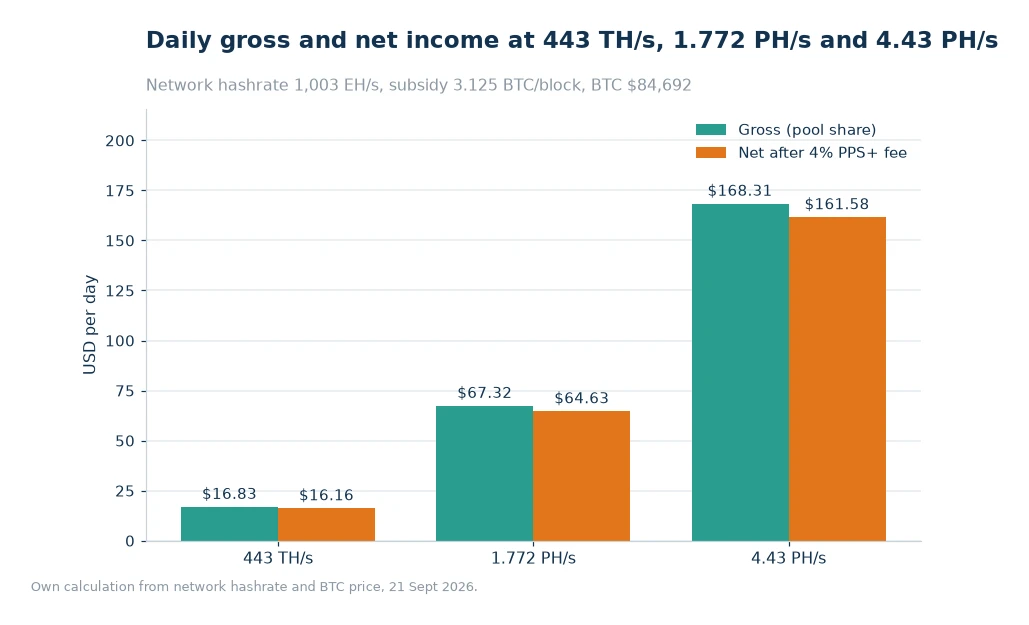
A miner who expects a hardware batch in six weeks faces a timing problem: the invoice arrives now and the machines earn later. Borrowing against coin already held is one way to bridge that gap without selling. At 443 TH/s the daily credit is about $16.83 before the listed fee, or $16.16 after the 4% on the block-reward component.
Key takeaways
- 443 TH/s produces 0.00019873 BTC a day, about $16.83 gross and $16.16 net of the listed 4%.
- 1.772 PH/s, four times that hashrate, produces $67.32 gross and $64.63 net per day.
- A pledge keeps the coin in place instead of converting it, so the position stays exposed while the loan is open.
- Repayment has to come from a named source, usually mining income, before the loan is applied for.
Selling coin to buy hardware, and why operators hesitate
Paying cash for machines is the simplest route and the one most operators take. It also means converting whatever coin funded the purchase, which fixes a price at the moment of the order. An operator who believes the coin is worth more later has a reason to prefer a loan: the collateral stays put, and the hardware is bought with borrowed value instead of sold value.
That preference is not free. A loan carries its own cost and its own risk, and the pledged coin can be lost if the position is not maintained. The decision is therefore not "loan versus no cost" but "which cost, and can the mining income cover it". Writing that comparison down before applying is the difference between a financing plan and a hope.
Timing is the other half of the argument. Hardware batches ship on someone else's schedule, and a miner who waits to accumulate the full invoice price may watch the machines sell out. Paying now and earning later is a normal trade in any capital-heavy business, and the only question is whether the bridge is short enough that the interest stays small relative to the delivery it unlocks.
Daily cash flow at three operating sizes
Before any loan figure makes sense, the operation needs a daily number. The chart below uses three sizes that differ by a factor of four and ten, which makes the scaling easy to check. Fees are the listed 4% rate on the PPS-settled block-reward component; the transaction-fee side carries its own 2% rate and is not folded into this comparison.
Sizing the position also means knowing how many days the bridge will last. A loan that covers a six-week delivery window is a different instrument from one that covers six months of building work, and the shorter one is much easier to match against mining income.
The net column is what a repayment schedule should be built on. Gross income is a useful headline, but a lender is repaid from what remains after the pool's listed fee, not from the number above it.
Gross and net at three hashrates
The rows hold BTC at $84,692 and use the same network inputs throughout.
| Hashrate | BTC per day | Gross per day | Net per day |
|---|---|---|---|
| 443 TH/s | 0.00019873 | $16.83 | $16.16 |
| 1.772 PH/s | 0.00079492 | $67.32 | $64.63 |
| 4.43 PH/s | 0.00198732 | $168.31 | $161.58 |
A repayment plan built on the net column has a margin of about four percent against the gross, which is thinner than it looks once power is subtracted. Electricity is not in this table at all, and it is usually the largest single expense. A loan sized against gross income without a power line is sized against a number the operator never actually receives.
Worked example
The three sizes are simple multiples, so one calculation covers all of them.
- Output per TH/s: 450 ÷ 1,003,000,000 = 0.00000044865 BTC daily.
- At 443 TH/s: 443 × 0.00000044865 = 0.00019873 BTC a day.
- Gross value: 0.00019873 × 84,692 = $16.83.
- Listed 4% on the block-reward component: 16.83 × 0.04 = $0.67.
- Net: 16.83 − 0.67 = $16.16.
- At 1.772 PH/s, four times the hashrate: 0.00079492 BTC a day, $67.32 gross and $64.63 net.
- At 4.43 PH/s, ten times: 0.00198732 BTC a day, $168.31 gross and $161.58 net.
The five steps of a pledged loan
The process on ViaBTC runs in a fixed order, and knowing it in advance makes the timeline easier to plan around a hardware delivery.
- Add Collateral — pledge coin from the account, which stays in place rather than being sold.
- Apply for Loan — state the amount against the pledged value.
- Receive Loan — the borrowed funds arrive, ready for the hardware invoice.
- Repay Loan — return the borrowed amount, in part or in full according to the terms.
- Redeem Collateral — release the pledged coin once the loan is settled.
ViaBTC Crypto Loan is the entry point for the process, and the product name on the page is Collateral-Pledged Loans. The order matters: collateral is pledged before the application, and the coin is only released after repayment and redemption. Skipping a step usually means waiting, not losing funds, but it does mean the hardware sits in its box for longer than planned.
Sizing a repayment from mining income
Start with the net daily figure at the hashrate that will actually be running, not the hashrate on the order form. If the new machines add 1.772 PH/s and the existing rack already produces 443 TH/s, the combined operation is closer to 2.2 PH/s, and the repayment capacity should be built on the combined net, less power.
A conservative plan leaves room for a difficulty change and for the weeks when a machine is offline. If net income is $64.63 a day at 1.772 PH/s, a repayment that consumes the whole figure has no buffer at all. Setting the instalment well below that number keeps the plan intact through a bad month, which is the only kind of month that tests a schedule. A buffer is not pessimism; it is the difference between a plan that survives one repair and one that does not.
Keep the borrowed funds and the mining balance visible in the same account where possible. The multi-currency wallet holds both, so a repayment can be made from mined coin without moving value through an exchange first. Fewer transfers means fewer delays, and delays are what turn a six-week bridge into a three-month one.
Check the numbers again after the first repayment. A schedule written before the machines arrived is a guess; one revised after a month of real credits is a plan. The revision should take minutes, since the only inputs are the hashrate actually online and the net figure it produced.
Frequently asked questions
What can be pledged for a Collateral-Pledged Loans position?
Coin held in the account, pledged through the Add Collateral step before the application. The collateral stays in place while the loan is open and is released at the Redeem Collateral stage.
How much can 1.772 PH/s repay per day?
About $64.63 net of the listed 4% on the block-reward component, before power. Any repayment plan should be built below that figure to leave room for difficulty changes and downtime.
Does borrowing remove the coin from the account?
No. Pledging locks the collateral rather than selling it, so the coin remains part of the position until the loan is repaid and the collateral is redeemed.
Name the repayment source before you borrow
Write the source on the same page as the amount: which machines, at what hashrate, producing what net daily figure. At 443 TH/s that figure is $16.16, and at 4.43 PH/s it is $161.58. If the instalment fits comfortably inside the smaller number, the plan has room. If it only fits inside the larger one, the order is probably too big for the income behind it.
Sources: the loan, pricing and wallet sections of viabtc.com, where the Collateral-Pledged Loans steps and the 4% block-reward rate are set out[1]. Chain data read 21 Sept 2026: 1,003 EH/s, 3.125 BTC per block, BTC $84,692. Published 24 Oct 2026; income excludes power and assumes continuous uptime.