Natural Skincare Ingredients in an Eye Cream Brief
Choosing natural ingredients for an eye cream is a pairing problem before it is a shopping list. The client's ingredient page screens every candidate three ways: active performance, skin compatibility with user experience, and market positioning against consumer needs. The same page lists retinol, peptides, hyaluronic acid, vitamin C, caffeine, niacinamide and botanical extracts, and it flags ingredient compatibility and stability testing as the work that decides how many of them can travel together.
Key takeaways
- Screen each ingredient on active performance, compatibility with user experience, and market fit.
- A shorter, well-paired list beats a longer list that overloads the formula.
- Ingredient compatibility and stability testing are development steps, and reports take 3–6 months.
- A sensitive-skin claim waits on patch test results, so wording and testing move together.
What natural should mean in a brief
Building a natural skincare ingredients list is not the same as choosing a single label for a jar. It is a direction that shapes which families a formulator is allowed to reach for and how the finished cream should feel. An eye cream is a small, thin product used close to the eye, so texture tolerance is tighter than in a face cream and the brief has to say so.
The client's guidance keeps the evaluation practical. A candidate has to earn its place on active performance, on skin compatibility and user experience, and on market positioning and consumer needs. Run every name through those three questions and the list usually shortens itself before the lab ever weighs a sample.
The three-part screen for every candidate
The first question is what the ingredient actually does in the finished cream, not what it does in a marketing story. The second is whether it sits comfortably on the skin at the amount needed, because an eye cream cannot afford a heavy hand. The third is whether the buyer recognises the name and values it, since a great actives list that the market does not understand still does not sell.
| Ingredient family | Usual role in an eye cream | Screen to apply |
|---|---|---|
| Peptides | Support the firmness language on pack | Confirm load feels light near the eye |
| Hyaluronic acid | Carries the hydration message | Check it layers with the base |
| Vitamin C | Adds a brightening direction | Test compatibility and colour stability |
| Retinol | Leads the renewal direction | Screen tolerance and pairing limits |
| Botanical extracts | Fills out the natural story | Confirm the name is understood by buyers |
Notice that no row is a verdict. Each row is a question the brief should force the lab to answer, which is what turns a list of names into a formula that can be defended on pack.
Pairing rules decide how many actives travel together
Two good ingredients can still make a difficult cream. Compatibility is the reason the client's page treats pairing as a development consideration rather than a footnote. Some actives want different pH ranges, some compete for the same skin pathway, and some simply do not sit well at the concentration each one needs to look credible.
The safe habit is to name one lead active and at most one supporting active, then let the rest of the formula carry texture and preservation. A base with a strong hydrating system and a single hero direction is easier to stabilise, easier to explain and easier to test than a formula crowded with five headline names. That is how a natural brief stays natural instead of becoming muddy.
Botanical extracts and the packaging question
Botanical extracts are where a natural brief most often drifts. Their names read well, but each one adds a variable to compatibility and to odour, and odour drives decisions about fragrance that an eye cream may want to avoid. The client's page lists botanical extracts alongside the more technical actives, so they belong in the brief as named choices rather than as a generic category.
The other half of this decision is packaging. A formula with delicate actives may need an airless pump or an opaque container to stay as designed, and packaging lead time is named on the site as one of the schedule influences. Deciding the pack late, after the actives are fixed, is how a good formula reaches the shelf in a container that shortens its life.
Where ingredient compatibility testing sits in the window
Put the published project numbers on one timeline. An ODM project runs 4–8 weeks on an existing formula, and the stability and compatibility reports that settle ingredient pairing take about 13–26 weeks. Take the two edges: planning to the inner edge gives 4 + 13 = 17 weeks from kickoff to a defensible claim, and planning to the outer edge gives 8 + 26 = 34 weeks. The spread between those two plans is 34 - 17 = 17 weeks, which is the cost of assuming the fastest window from both columns at once. The testing band on its own is 26 - 13 = 13 weeks wide, and each extra active family is a reason to sit nearer the high end.
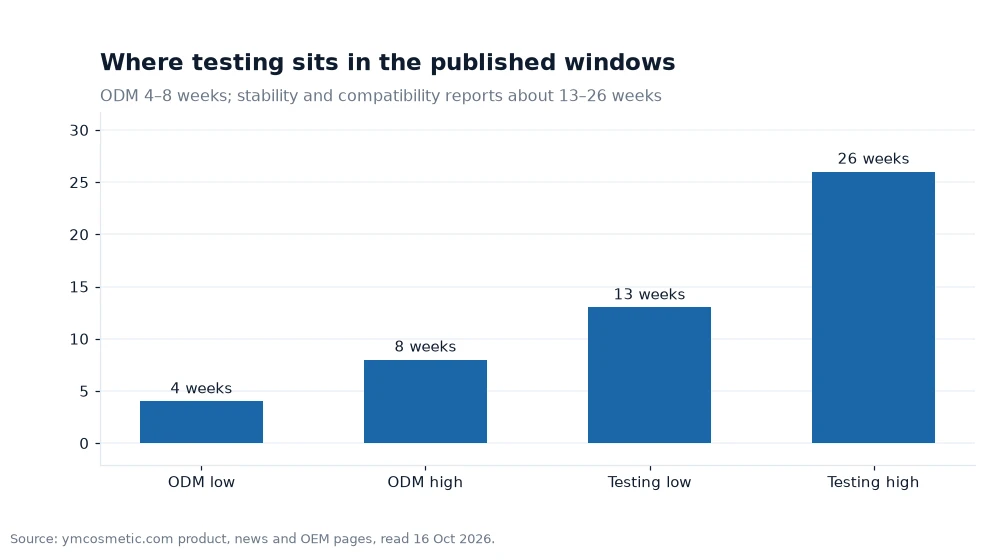
The two bars worth reading first are 13 and 26. The 13 is the earliest point at which a compatibility result can settle the ingredient list, so it is the soonest a natural claim can be locked. The 26 is the point a crowded formula should budget for, because every additional pairing is a chance the report needs longer. Planning the brief so the active list is short is how a brand stays closer to 13 than to 26.
Claims, patch tests and sensitive-skin wording
A sensitive-skin claim is a separate promise from a natural one, and the client's site states plainly that sensitive-skin claims need patch test results. That means the wording cannot be finalised on the strength of the ingredient list alone. The claim and the test move together on the calendar, and the test has to sit inside the overall schedule rather than after it.
The wider testing figure stays the same: stability and compatibility reports take 3–6 months. Build the claim around what those two documents can support, and keep any stronger phrasing in reserve until the paperwork is in hand. A modest claim that ships on schedule is worth more than a bold one that waits on a report.
Writing the brief so the lab can answer
Give the lab three things: the lead active with a target amount, the supporting ingredient and the reason it is there, and the texture the finished cream must hit. With those named, the pairing questions get answered in the sample round instead of the third revision. Leave the rest of the formula to the base, where texture and preservation are easier to hold steady.
Then write down what the claim depends on. If it depends on a compatibility result, the brief should say so, because that single sentence tells the planner which column of the testing window to watch. A brief that names its own evidence is a brief a lab can schedule rather than guess at.
Frequently asked questions
How many actives should an eye cream brief name?
A lead active plus one supporting active is usually enough; the client's page treats ingredient compatibility as a development step, and a shorter list is easier to stabilise and test.
Do natural ingredients need extra testing?
They run through the same compatibility and stability work, and the reports take 3–6 months whether the ingredient family is botanical or synthetic.
When does a sensitive-skin claim get confirmed?
The client's site states that sensitive-skin claims need patch test results, so the wording is confirmed once those results are in hand.
Keep the list short and the evidence clear
The strongest natural eye cream brief is the one that can explain every ingredient it keeps. Yunmei supports OEM/ODM eye cream projects with a formula library of over 10,000 mature formulas and fine-tuning across fragrance, texture and skin feel, so a short active list can still reach the feel the brand wants. Start from the eye cream category page to see the formats already on file and how the one-stop OEM and ODM service fits the testing calendar.
The numbers cited were read from the manufacturer's published pages on 16 Oct 2026 and are restated, not retested.[1]