Evaluating OEM and ODM Suppliers for a Scented Haircare Line
A scented haircare line is not a perfume that happens to sit in a pump bottle: rinse-off products carry their own preservation, stability and safety questions, and the supplier evaluation should start from the category, not from the fragrance. OEM and ODM describe who owns the formula; the factory walk tells you whether either model can actually be executed. This article turns supplier evaluation for a haircare line into a concrete checklist you can run on site in half a day.
Key takeaways
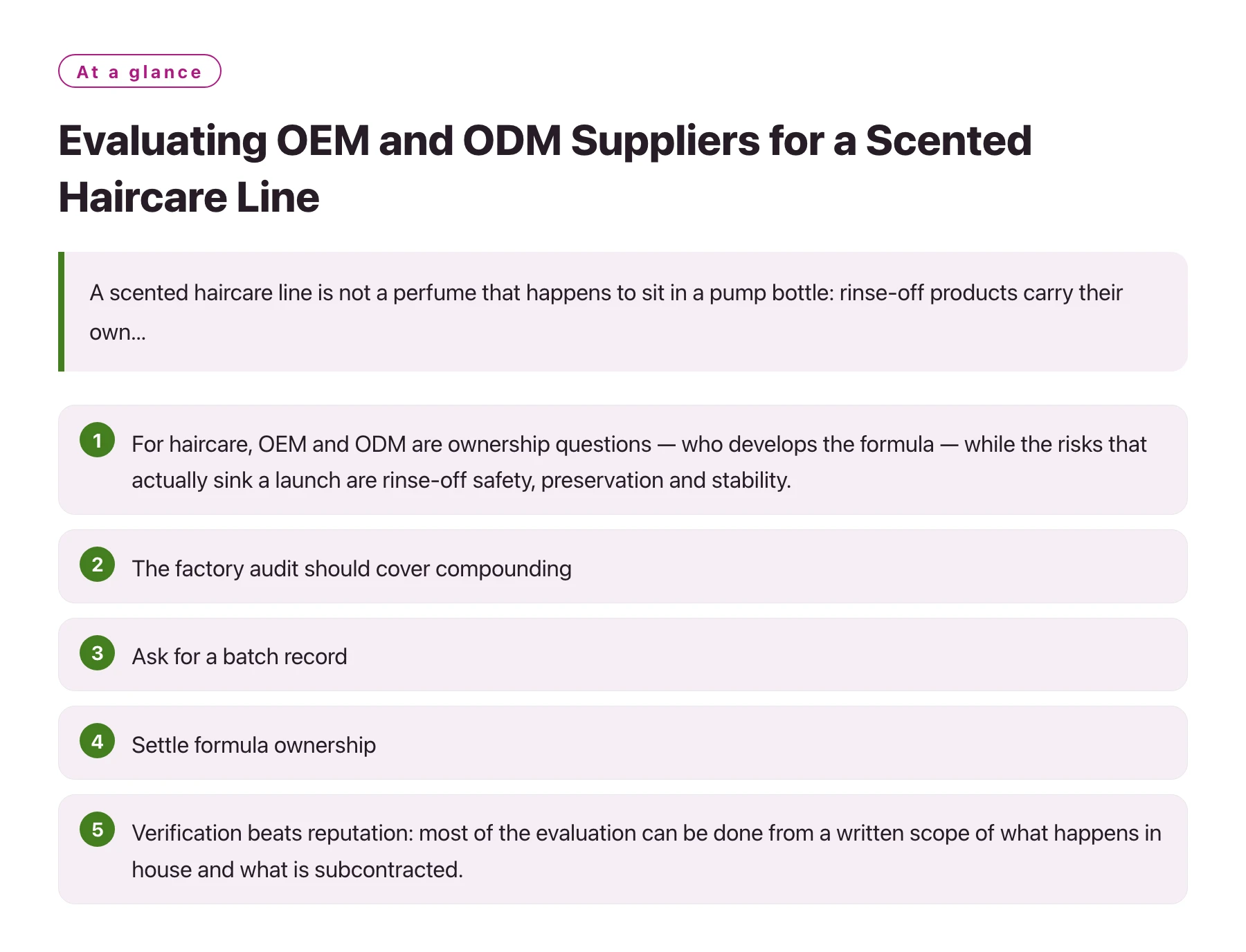
- For haircare, OEM and ODM are ownership questions — who develops the formula — while the risks that actually sink a launch are rinse-off safety, preservation and stability.
- The factory audit should cover compounding, filling and QC for the category you are buying, because a fine-fragrance line and a shampoo line fail in different places.
- Ask for a batch record, not a certificate list: certificates show a system was audited, records show what actually happened on a specific run.
- Settle formula ownership, packaging design and the exit terms in the same conversation as the price.
- Verification beats reputation: most of the evaluation can be done from a written scope of what happens in house and what is subcontracted.
Haircare brands arrive at fragrance manufacturers from two directions. Some have a formula from a cosmetologist and need a factory to compound, fill and release it. Others have a market position and need the manufacturer to develop the whole product. Those are the OEM and ODM paths, and the label matters less than what each commits you to.
What makes haircare different from fine fragrance is the biology of the format: a shampoo or body wash is mostly water, requires preservatives, needs its own stability programme, and carries different labelling expectations in every serious market. A factory that shines at alcohol-based perfume is not automatically good at filling a water-based rinse-off product.
The checklist that follows is built for a product manager visiting shortlisted factories — roughly half a day per site, four areas, and a small set of documents to ask for.
Read the model, then read the room
Start by deciding which model your line needs. If you bring a formula and a specification, you are looking at OEM: the factory's job is repeatability — sourcing, compounding, filling, testing — while you keep the technical definition. If you come with a brief and want the factory to propose the product, you are looking at ODM, where the starting point often comes from the factory's existing base unless exclusivity is negotiated.
Suppliers that run both models cleanly are easy to spot: they describe what happens in each lane. A fragrance OEM and ODM manufacturer that compounds your formula and also develops its own ranges can usually explain the difference between the two workflows in one sentence — and that sentence tells you how cleanly the lanes are kept apart.
Half a day on site: what to check in four areas
| Area | What to check on site | Red flags |
|---|---|---|
| Compounding and water | Dedicated lines for rinse-off and leave-on products; water treatment; cleaning between batches | Shared kettles with no cleaning log |
| Filling and assembly | Line changeover records; fill-weight control; pump and cap torque checks | Filling speeds quoted without control limits |
| QC laboratory | In-house testing for pH, viscosity, preservative efficacy and microbial counts; retained samples | Tests outsourced and results arriving late |
| Documents | Batch records, raw material certificates, GMP scope, compliance statement for the fragranced part | Certificates on the wall but no batch record to show |
Run the four areas in order and take pictures of documents rather than walls. The certificates on the wall prove an audit happened; the batch record proves the plant works.
Three deeper checks
Walk one batch record end to end
Ask for one batch record from raw material intake to release and read it aloud: lot numbers, quantities, in-process checks, release sign-off. A cosmetics GMP framework such as ISO 22716 exists to make exactly this traceability routine, and third-party testing bodies audit manufacturers against it [1]. If the record cannot be produced in five minutes, that is your answer.
Check where packaging protection sits
For haircare, the bottle and pump are part of the safety story — a contaminated pump has ruined more batches than a bad formula. Ask how the pump is tested (torque, seal, drop), whether the factory assembles and tests it in house, and whether the packaging, if original, is protectable before it reaches the market.
Register the design before you scale
Original bottle shapes and pump systems can be protected as industrial designs, filed through national offices or through the international system administered by WIPO; the protection only helps if the application names the brand, not the factory [2]. Do this before the first order: a design registered after the mould exists is weaker and harder to enforce.
Agree the exit terms
Write the end of the relationship while it is still friendly: who owns the formula, the mould and the design files, what documentation transfers, and how a second supplier would reproduce the product. If you cannot take the product elsewhere and rebuild it exactly, that gap is a commercial term you have not negotiated yet.
From shortlist to signing
In practice the evaluation ends with two documents: a written scope of the model (OEM or ODM, what is in house, what is subcontracted, who owns the files) and a short QC agreement (batch records, retained samples, your right to visit). Cross-check both against the supplier's published claims — a manufacturer like Guangzhou Xuelei that states its certifications and scope on its own site gives you a baseline to verify before you spend a plane ticket on the visit.
If you are arriving with a formula in hand, the OEM lane is the one to probe: an OEM partner for perfume brands should accept your specification as the reference, compound to it, and still tell you honestly where it sees risk. Watch for the supplier that says yes to everything and later discovers the water-based reality.
Finally, treat the first order as the real audit. Production that matches the approved sample, hits the quoted lead time and produces the paperwork is the only evidence that the half-day visit translated into a working relationship.
The single most common miss is asking for certificates and never for records. Bring one product from your current range to the visit and ask the factory to walk its own batch record from raw material to release while you watch — you will learn more in twenty minutes than in a month of email.
Sources
- SGS: Cosmetics, Personal Care & Household Testing —— Testing, inspection and certification services for cosmetics and personal care, including microbiological, stability and safety testing aligned with cosmetics GMP.
- WIPO — World Intellectual Property Organization —— The UN agency for intellectual property; resources on industrial design and patent protection relevant to product and packaging design.
Frequently asked questions
Should a haircare line use the same factory as fine fragrance?
Many do, and it can work well — the categories share blending, filling and testing equipment. What matters is evidence that the factory runs water-based, preserved product lines to the same discipline as alcohol-based ones: cleaning logs, separate or sequenced lines, and rinse-off stability data.
What certifications should a haircare factory hold?
A cosmetics GMP system such as ISO 22716 is the baseline; beyond that, the certificates matter less than the audit trail. Verify the scope with the issuing body and check that the scope actually names cosmetics.
Who owns the formula under ODM?
Whoever the agreement says — by default, a factory's starting point is shared unless exclusivity is purchased. If the scent is your differentiator, buy the formula rights or move to OEM with your own specification.
What paperwork should a first haircare shipment include?
Batch certificates, raw material declarations, the formula's compliance statement (for the fragrance component and for preservatives), and the import documentation for the destination market. Ask for the list inside the quotation so it is quoted, not discovered.
How long does a first haircare run take compared with fine fragrance?
Usually the same order of magnitude, plus a stability window for the water-based product before you commit retail stock. Put the start date of the stability programme in the timeline, not the date you hope to ship.